MDDemat
The MDDemat project aims to establish the digitalisation of transport documents. It specifically targets dangerous goods transported by road, rail or waterways.
This project addresses many challenges :
Enabling forces of law and order to quickly access transport documents for secure, reliable, and seamless inspections. Public authorities can therefore strengthen their cooperation with carriers through clear traceability and instant data transmission.
Enabling the rapid transmission of information to emergency services in the event of an accident, thereby granting them greater efficiency in their mission of protecting people and the environment.
Offering French companies the opportunity to position themselves as leaders in this new market of transport decarbonisation.
Lead to the commercialisation of a web service usable by shippers, loaders, and carriers. This web service is designed to manage information and documents related to dangerous goods. It will respond to various requests made by authorities and emergency services.
Help to market a mobile application designed to replace the paper documents currently required on board each vehicle. Additionally to reduce fuel consumption by optimising journeys.
Needs
Legislation on the transport of dangerous goods (ADR/ADN/RID) is evolving with the introduction of electronic transport documents.
This involves the creation of secure websites that act as trusted third party for carriers, authorities, and emergency services.
Therefore, every carrier must be able to :
- Upload electronic transport documents to a secure website
- Link these documents to the transport unit from loading to delivery
- To ensure that only authorised and identified individuals have access to the documents
Similarly, the trusted third party for public actors must ensure their secure connection with those of the transport operators in order to :
- Ensuring the 24/7 availability of information related to the transport of hazardous materials
- Obtain electronic documents in case of need (accident)
- Simply establish reliable statistics
This forms the core and foundation of the system architecture.
The simplicity of this system should allow partners, shippers and other logistics players to easily share electronic data with carriers.
The trusted third party must also offer value-added services to help the various stakeholders in monitoring and traceability as well as in reporting.
Digitalisation will eliminate paper documents and provide fluidity and rigor in the transfer of information between the various national and international logistics players.
General architecture
The system architecture is the key element of MDDemat, and particular attention will be paid to this aspect of the specifications. Indeed, most projects developed to date have proposed models with a strong centralised component. Recent trends have shown that these models are categorically rejected in the freight transport sector.
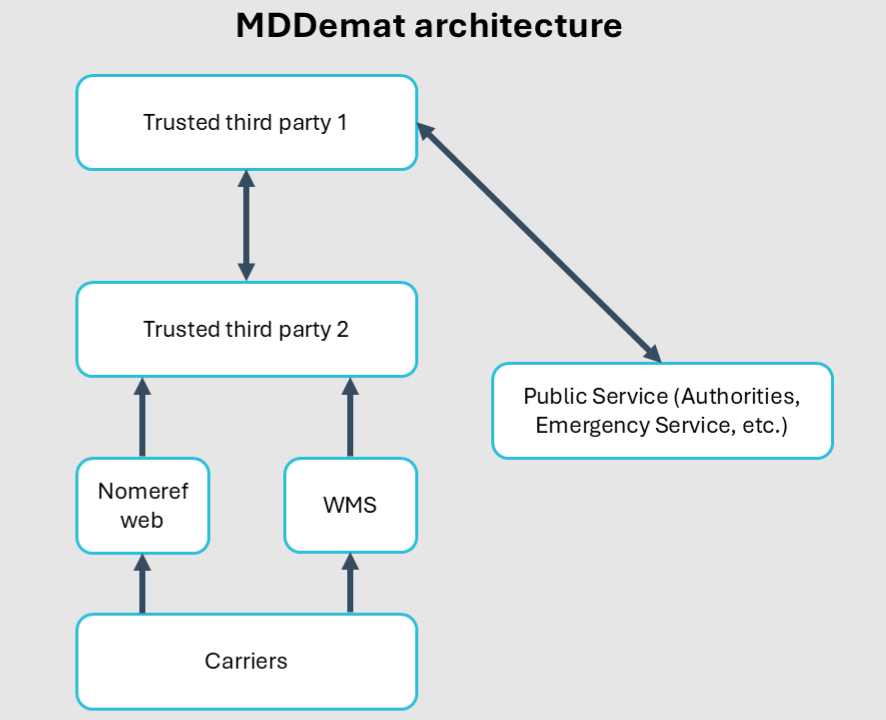
To meet these needs, the system architecture is comprised of two trusted third parties. These third parties enable electronic access to all documents related to the transport of hazardous materials :
- The trusted third party 2 (Level 2 trusted third party) which securely stores transport documents for one or more carriers.
- The trusted third party 1 (Level 1 trusted third party) acts as a link between institutional actors such as public authorities (emergency services, forces of law and order, customs, infrastructure managers, traffic managers, etc.) and the various existing trusted third parties 2. The latter transmit transport documents to the trusted third party 1 when requested by the competent authorities.
For example, during a roadside check by forces of law and order, they request the trusted third party 1 to retrieve transport documents from the truck’s license plate.
A trusted third party 2 is always connected to only one trusted third party 1, while a trusted third party 1 can be connected to several trusted third parties 2 simultaneously.
Several trusted third parties 1 can exist (one per country for instance), each connected to the other trusted third parties 1 to guarantee the smooth and secure exchange of documents.
When a trusted third party 1 is requested, if a truck is not recognised, the trusted third party 1 queries the other trusted third parties 1 to automatically retrieve the transport document.
For this project, NeoGLS is in charge of the development of the trusted third party 1.
The term carrier refers to transport companies that move goods from one point to another. Carriers interact with shippers, shippers, and public services.
In order to transmit transport documents and information to the trusted third party 2, carriers use various ways.
The first method is to use Nomeref web, a platform provided by our partner MD Service. This allows small transport companies to create a goods transport document, with several access levels (administrator, user, operator, etc.). The Nomeref web interface allows users to create, track, and modify shipments and packages.
The second way to proceed is to use a WMS (Warehouse Management System). A carrier possessing the hazardous materials data in “raw” state and recorded in a WMS, can send the basic data to trusted third party 2 via a web service.
The benefits of MDDemat
Reduction of administrative costs
Eliminating paper documents reduces workload, data entry errors, and logistics processing costs.
Enhanced responsiveness in case of an accident
Emergency services can access the documents in seconds, allowing for a faster and more targeted intervention.
Optimised security and traceability
Access to documents is secure, controlled and traceable. Only authorised persons can view sensitive data.
Simplicity for all stakeholders
Partners, shippers and carriers easily share data through a clear interface and a flexible system.
Real-time logistics tracking
Digital documents allow for instant visualisation of the status of each shipment at every stage of transport.
24/7 access to critical documents
The authorities can consult the necessary documents at any time, even outside of office hours.

Compliance with RID/ADR/ADN standards
The system responds to regulatory changes and anticipates future obligations regarding the transport of dangerous goods.

Respect for the environment
Digitalisation enables greener logistics by reducing printing, unnecessary journeys and paper consumption.
This project was funded by the French State as part of France 2030 operated by ADEME, and funded by the European Union – NextGenerationEU.